
Policy Recommendations
- Fiscal Cut spending in the areas of most overspending relative to national averages. Use the proceeds to reduce the corporate income tax and help the economy diversify away from energy.
- Regulatory Enact a right-to-work law to attract manufacturing investment.
- Personal Reform asset forfeiture to require a criminal conviction before forfeiture and to require Department of Justice equitable-sharing proceeds to follow the same procedure.
Analysis
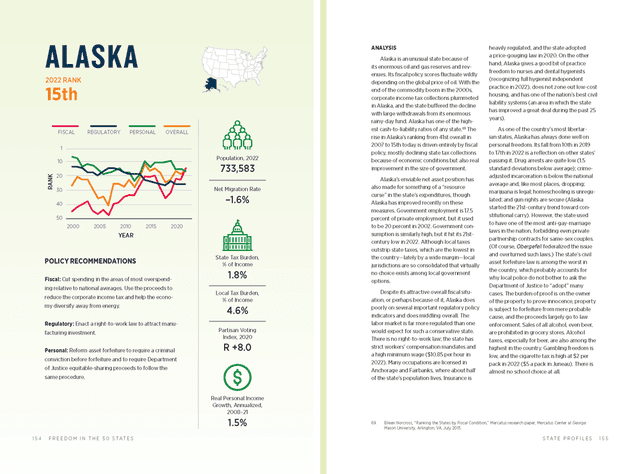
Alaska is an unusual state because of its enormous oil and gas reserves and revenues. Its fiscal policy scores fluctuate wildly depending on the global price of oil. With the end of the commodity boom in the 2000s, corporate income tax collections plummeted in Alaska, and the state buffered the decline with large withdrawals from its enormous rainy-day fund. Alaska has one of the highest cash-to-liability ratios of any state. The rise in Alaska’s ranking from 41st overall in 2007 to 15th today is driven entirely by fiscal policy, mostly declining state tax collections because of economic conditions but also real improvement in the size of government.
Alaska’s enviable net asset position has also made for something of a “resource curse” in the state’s expenditures, though Alaska has improved recently on these measures. Government employment is 17.5 percent of private employment, but it used to be 20 percent in 2002. Government consumption is similarly high, but it hit its 21st-century low in 2022. Although local taxes outstrip state taxes, which are the lowest in the country—lately by a wide margin—local jurisdictions are so consolidated that virtually no choice exists among local government options.
Despite its attractive overall fiscal situation, or perhaps because of it, Alaska does poorly on several important regulatory policy indicators and does middling overall. The labor market is far more regulated than one would expect for such a conservative state. There is no right-to-work law; the state has strict workers’ compensation mandates and a high minimum wage ($10.85 per hour in 2022). Many occupations are licensed in Anchorage and Fairbanks, where about half of the state’s population lives. Insurance is heavily regulated, and the state adopted a price-gouging law in 2020. On the other hand, Alaska gives a good bit of practice freedom to nurses and dental hygienists (recognizing full hygienist independent practice in 2022), does not zone out low-cost housing, and has one of the nation’s best civil liability systems (an area in which the state has improved a great deal during the past 25 years).
As one of the country’s most libertarian states, Alaska has always done well on personal freedom. Its fall from 10th in 2019 to 17th in 2022 is a reflection on other states’ passing it. Drug arrests are quite low (1.5 standard deviations below average); crime-adjusted incarceration is below the national average and, like most places, dropping; marijuana is legal; homeschooling is unregulated; and gun rights are secure (Alaska started the 21st-century trend toward constitutional carry). However, the state used to have one of the most anti-gay-marriage laws in the nation, forbidding even private partnership contracts for same-sex couples. (Of course, Obergefell federalized the issue and overturned such laws.) The state’s civil asset forfeiture law is among the worst in the country, which probably accounts for why local police do not bother to ask the Department of Justice to “adopt” many cases. The burden of proof is on the owner of the property to prove innocence, property is subject to forfeiture from mere probable cause, and the proceeds largely go to law enforcement. Sales of all alcohol, even beer, are prohibited in grocery stores. Alcohol taxes, especially for beer, are also among the highest in the country. Gambling freedom is low, and the cigarette tax is high at $2 per pack in 2022 ($5 a pack in Juneau). There is almost no school choice at all.