
Policy Recommendations
- Fiscal Reduce the bloated government payroll and apply the proceeds to reduce the sales tax.
- Regulatory Significantly reform occupational licensing, initiating a robust sunrise review process and expanding scope of practice for health care paraprofessionals.
- Personal Legalize sports betting and avoid tax loss to neighboring states.
Analysis
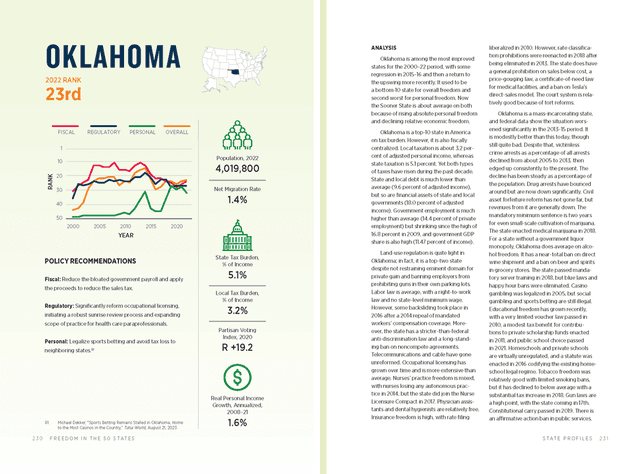
Oklahoma is among the most improved states for the 2000–22 period, with some regression in 2015–16 and then a return to the upswing more recently. It used to be a bottom-10 state for overall freedom and second worst for personal freedom. Now the Sooner State is about average on both because of rising absolute personal freedom and declining relative economic freedom.
Oklahoma is a top-10 state in America on tax burden. However, it is also fiscally centralized. Local taxation is about 3.2 percent of adjusted personal income, whereas state taxation is 5.1 percent. Yet both types of taxes have risen during the past decade. State and local debt is much lower than average (9.6 percent of adjusted income), but so are financial assets of state and local governments (18.0 percent of adjusted income). Government employment is much higher than average (14.4 percent of private employment) but shrinking since the high of 16.8 percent in 2009, and government GDP share is also high (11.47 percent of income).
Land-use regulation is quite light in Oklahoma; in fact, it is a top-two state despite not restraining eminent domain for private gain and banning employers from prohibiting guns in their own parking lots. Labor law is average, with a right-to-work law and no state-level minimum wage. However, some backsliding took place in 2016 after a 2014 repeal of mandated workers’ compensation coverage. Moreover, the state has a stricter-than-federal anti-discrimination law and a long-standing ban on noncompete agreements. Telecommunications and cable have gone unreformed. Occupational licensing has grown over time and is more extensive than average. Nurses’ practice freedom is mixed, with nurses losing any autonomous practice in 2014, but the state did join the Nurse Licensure Compact in 2017. Physician assistants and dental hygienists are relatively free. Insurance freedom is high, with rate filing liberalized in 2010. However, rate classification prohibitions were reenacted in 2018 after being eliminated in 2013. The state does have a general prohibition on sales below cost, a price-gouging law, a certificate-of-need law for medical facilities, and a ban on Tesla’s direct-sales model. The court system is relatively good because of tort reforms.
Oklahoma is a mass-incarcerating state, and federal data show the situation worsened significantly in the 2013–15 period. It is modestly better than this today, though still quite bad. Despite that, victimless crime arrests as a percentage of all arrests declined from about 2005 to 2013, then edged up consistently to the present. The decline has been steady as a percentage of the population. Drug arrests have bounced around but are now down significantly. Civil asset forfeiture reform has not gone far, but revenues from it are generally down. The mandatory minimum sentence is two years for even small-scale cultivation of marijuana. The state enacted medical marijuana in 2018. For a state without a government liquor monopoly, Oklahoma does average on alcohol freedom. It has a near-total ban on direct wine shipment and a ban on beer and spirits in grocery stores. The state passed mandatory server training in 2018, but blue laws and happy hour bans were eliminated. Casino gambling was legalized in 2005, but social gambling and sports betting are still illegal. Educational freedom has grown recently, with a very limited voucher law passed in 2010, a modest tax benefit for contributions to private scholarship funds enacted in 2011, and public school choice passed in 2021. Homeschools and private schools are virtually unregulated, and a statute was enacted in 2016 codifying the existing homeschool legal regime. Tobacco freedom was relatively good with limited smoking bans, but it has declined to below average with a substantial tax increase in 2018. Gun laws are a high point, with the state coming in 17th. Constitutional carry passed in 2019. There is an affirmative action ban in public services.