
Policy Recommendations
- Fiscal Eliminate the bank franchise tax.
- Regulatory Amend the constitution to require a supermajority (say, 60 percent) to pass any new regulatory infringement on the rights of private citizens through the initiative process. This change could help with both labor-market and tobacco freedoms.
- Personal Reform asset forfeiture to place the burden of proof on the government, not on innocent owner claimants, and direct funds to the state treasury, not to the seizing departments.
Analysis
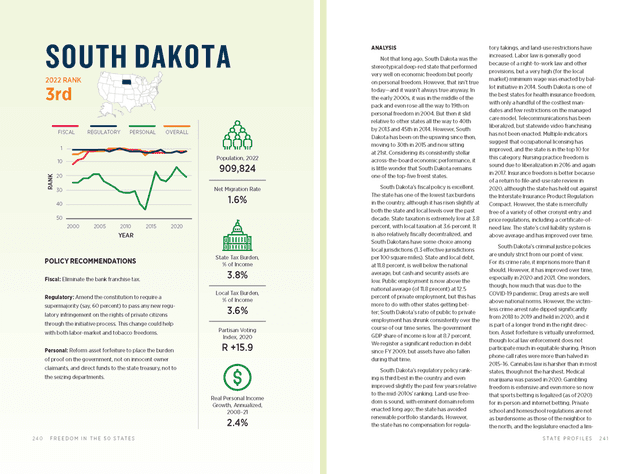
Not that long ago, South Dakota was the stereotypical deep-red state that performed very well on economic freedom but poorly on personal freedom. However, that isn’t true today—and it wasn’t always true anyway. In the early 2000s, it was in the middle of the pack and even rose all the way to 19th on personal freedom in 2004. But then it slid relative to other states all the way to 40th by 2013 and 45th in 2014. However, South Dakota has been on the upswing since then, moving to 30th in 2015 and now sitting at 21st. Considering its consistently stellar across-the-board economic performance, it is little wonder that South Dakota remains one of the top-five freest states.
South Dakota’s fiscal policy is excellent. The state has one of the lowest tax burdens in the country, although it has risen slightly at both the state and local levels over the past decade. State taxation is extremely low at 3.8 percent, with local taxation at 3.6 percent. It is also relatively fiscally decentralized, and South Dakotans have some choice among local jurisdictions (1.3 effective jurisdictions per 100 square miles). State and local debt, at 11.8 percent, is well below the national average, but cash and security assets are low. Public employment is now above the national average (of 11.8 precent) at 12.5 percent of private employment, but this has more to do with other states getting better; South Dakota’s ratio of public to private employment has shrunk consistently over the course of our time series. The government GDP share of income is low at 8.7 percent. We register a significant reduction in debt since FY 2009, but assets have also fallen during that time.
South Dakota’s regulatory policy ranking is third best in the country and even improved slightly the past few years relative to the mid-2010s’ ranking. Land-use freedom is sound, with eminent domain reform enacted long ago; the state has avoided renewable portfolio standards. However, the state has no compensation for regulatory takings, and land-use restrictions have increased. Labor law is generally good because of a right-to-work law and other provisions, but a very high (for the local market) minimum wage was enacted by ballot initiative in 2014. South Dakota is one of the best states for health insurance freedom, with only a handful of the costliest mandates and few restrictions on the managed care model. Telecommunications has been liberalized, but statewide video franchising has not been enacted. Multiple indicators suggest that occupational licensing has improved, and the state is in the top 10 for this category. Nursing practice freedom is sound due to liberalization in 2016 and again in 2017. Insurance freedom is better because of a return to file-and-use rate review in 2020, although the state has held out against the Interstate Insurance Product Regulation Compact. However, the state is mercifully free of a variety of other cronyist entry and price regulations, including a certificate-of-need law. The state’s civil liability system is above average and has improved over time.
South Dakota’s criminal justice policies are unduly strict from our point of view. For its crime rate, it imprisons more than it should. However, it has improved over time, especially in 2020 and 2021. One wonders, though, how much that was due to the COVID-19 pandemic. Drug arrests are well above national norms. However, the victimless crime arrest rate dipped significantly from 2018 to 2019 and held in 2020, and it is part of a longer trend in the right direction. Asset forfeiture is virtually unreformed, though local law enforcement does not participate much in equitable sharing. Prison phone call rates were more than halved in 2015–16. Cannabis law is harsher than in most states, though not the harshest. Medical marijuana was passed in 2020. Gambling freedom is extensive and even more so now that sports betting is legalized (as of 2020) for in-person and internet betting. Private school and homeschool regulations are not as burdensome as those of the neighbor to the north, and the legislature enacted a limited private scholarship tax benefit in 2016. Smoking bans are extreme, but taxes are low compared with other states. South Dakota is one of the best states in the country for gun rights and has improved in absolute terms since the fifth edition, with the passage of constitutional carry in 2019. Alcohol freedom is extensive, and the ban on direct shipment of wine was repealed in 2015.